Wednesday, September 18, 2019

How to Turn Organic Search into your Most Powerful Marketing Channel

https://s.w.org/images/core/emoji/11/72x72/1f642.png

Every single month, the “leaders” of every single industry in the world use organic traffic to reach otherwise impossible levels of success. The way they achieve success is straightforward — they generate tons of organic visitors from Google…

And that’s pretty much where the consensus ends 🙂

Every single month, we speak with countless companies who all understand how powerful this marketing channel is, and acknowledge that the leaders in their space are wildly successful.

When asked why they aren’t the ones reaping all the benefits, there are usually four excuses reasons why they aren’t at the top of the search results:

  • “Our industry is hyper competitive”
  • “We’ve tried to make a run but it didn’t work”
  • “The industry leaders got a huge head start”
  • “We don’t have the resources needed to catch up”

Dispelling the Organic Traffic Myths

Every single year, there are new players who enter an industry and catapult to the top of the search results.

Seemingly, they figured out how to cut the line.

Seemingly, they didn’t pay their dues.

Seemingly, they “caught up” even though they almost certainly had just a fraction of the resources.

How is this possible?

It’s actually pretty straightforward… formulaic, actually.

Take a look at what the leaders are doing, and make sure you have a plan to catch up (we’ll break this down in a second)

Mix in that correct strategy with the required execution, and you can achieve the same level of success.

For the rest of this article, we’re going to take a canonically “hyper competitive industry” and craft a plan to take down the leaders of the small business lending space: Lendio and Kabbage 

(as a reminder, the small business lending space has billion dollar startups, a who’s who of banks, and by the way the Small Business Administration as well)

TL;DR

  • They increase their website power at a specific rate with link building
  • They rank for over 125,000 keywords through a precise content strategy
  • Their pages are meticulously structured to maximize traffic from Google

What’s the value of Lendio and Kabbage’s traffic?
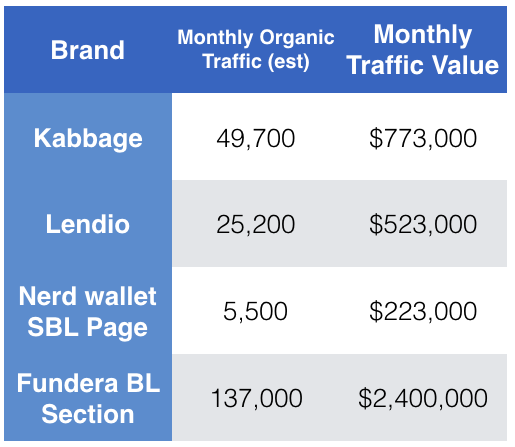
Using various research tools, we can provide an estimate of the amount of organic traffic a page or website receives each month. Additionally, we can determine how much money that organic traffic would cost each month to acquire via Google Ads (i.e. the cost if you were using PPC to acquire that traffic).

Comparing some of the companies who are at the top of the search results for business loans related terms, you can see that even a very small amount of traffic is worth a tremendous amount of money.

Lendio and Kabbage each generate over $6mm a year in traffic value.

For NerdWallet, a single page, their small business loans page, generates ~$250k/mo in organic traffic.

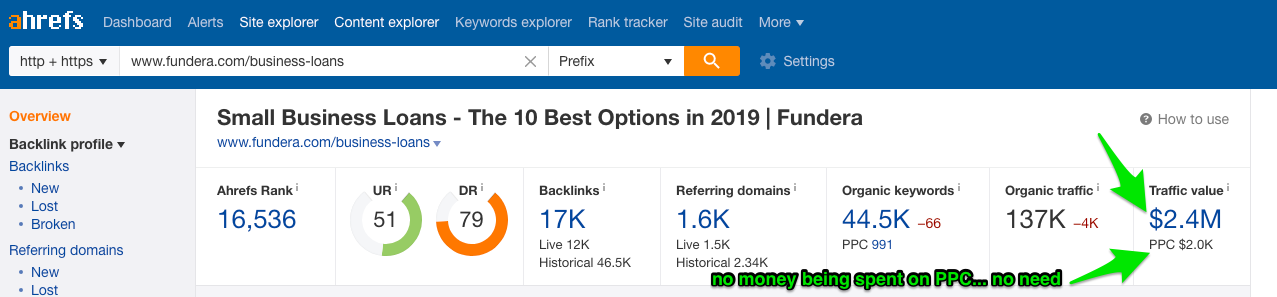
Fundera’s business loans section tops everyone at a whopping $2.4mm per month in organic traffic value:
 

How can these sites generate seemingly unlimited free traffic?

Even though the strategies and execution of  a successful campaign are complex, the “what” of organic traffic is fairly straightforward:

  1. Do you have a stronger, more ‘powerful’ website than your competition?
  2. Do you have all the necessary pages on your site to catch the most search traffic?
  3. Are those pages structured properly?

That’s the formula — answer those questions yes and you’ve unlocked a mountain of repeat visitors who inherently trust your site because they found it themselves.

1) Do the winners have stronger websites than the losers?

Using Domain Rating (DR), a 1-100 logarithmic rating, we can measure the strength of a given website, comparing the winners to losers in the industry:
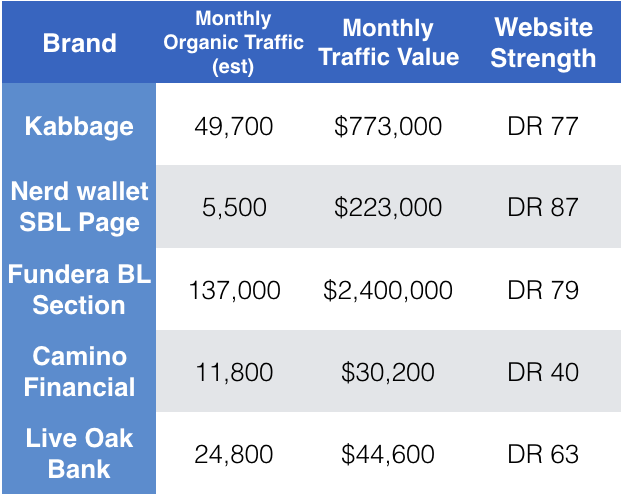
Undeniably, the more powerful the website (the higher the “DR”), the more traffic generated. (Remember, NerdWallet’s entry is a single page on their website).

How does a website become more powerful?

There’s only one way to get a more powerful website: Build links.

Build links increases the amount of referring domains (the amount of websites) that point to your own website.

By building quality links, you will increase the amount of powerful domains that point to your site. This will increase your authority, or DR (Domain Rating). With a high enough DR, you will appear higher in the search results by default and generate more organic traffic.

If you want to learn a little more about why link building is so important for search, check out our article deconstructing Google’s wants

Link Building Leads to a More Powerful Website and More Organic Traffic

Here are some great examples. Nerdwallet has been steadily building links since January 2014, and their traffic has been increasing the entire time (it’s up to 12.3mm monthly visitors).

Lendio really started to ramp up their link building in July of 2016, with the number of referring domains peaking in March of 2018.

But then, they stopped, and their referring domains started to decrease. So did their organic traffic.

Only in the last month or two have they picked their referring domains back up, and, unsurprisingly, their organic traffic increased as well.

How actively are the winners building links?

The question isn’t if the winners are building link, but rather: how much effort is being put into this process right now?

For example, Lendio paused their link building in March of 2018. Have they fully restarted? Here’s where the winners stand currently:

(Numbers are referring domains)

It looks like Lendio is building about 167 new referring domains per month, and Kabbage is around 300 per month. However, since their prior link building efforts may not have been the highest quality, they are losing significant amount of domains each month.

How to outperform the winners from a link building perspective

There are two different opportunities to catch up to the industry leaders, but they both come from the same principle:

Higher quality backlinks will remain live more frequently (you won’t ‘lose’ them), and higher quality backlinks are worth more (not all links are created equal)

Higher quality backlinks stay live more frequently:

Here’s a few examples of the ratios on gained/lost links that SearchTides has for our clients:

Controlling link relationships is a competitive advantage that leads to fewer links lost, which allows winners to be caught up to.

Higher quality link building means each link is worth more:

Although it sounds intuitive, there’s value in explicitly saying: not all links are created equal. There are a variety of filters that can be used to judge the quality of a link; for this conversation, it’s easier to use raw power (domain rating).

The stronger the domain linking to your site, the stronger the value of that link is.

As an example, here is the breakdown of the strength of the domains pointing to the Kabbage and Lendio websites, compared to what is typical of a SearchTides link building campaign:

If you build higher quality backlinks than the current winners, and you have a competitive advantage.

2) What’s the optimal content creation strategy to use?

How can you tell if a company has a successful content creation strategy?

You look at the number of page one rankings over time.

The most profitable terms in a space:

  • Small business loans
  • Business Loans
  • Etc

Are all well known and are a defined number of keywords.

If your website is ONLY talking about business loans or small business loans, even if you are moving from the #10 to #1 spot for those keywords, you aren’t increasing the number of keywords you rank for.

That’s what good content does.

New articles allow you to target additional keywords.

Which then work their way onto page one, and you generate search traffic as a result.

Let’s look at Kabbage and Lendio:
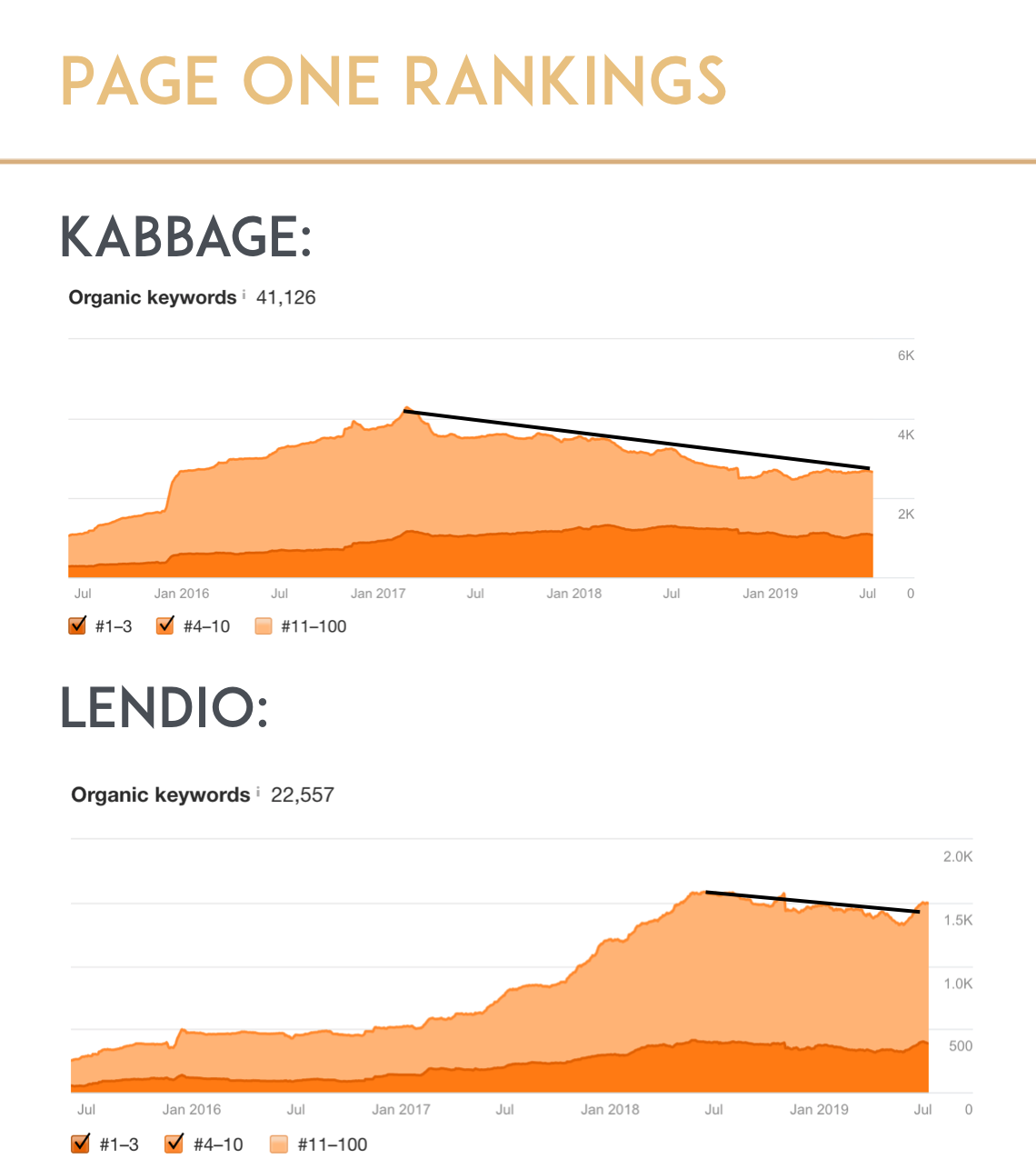
Although both sites had significant rises in page one rankings initially, they have both experienced a decrease in page one rankings since.

This drop is not due to the major keywords, such as “small business loans”, since Kabbage/Lendio remain on the first page, but rather, this decrease stems from the additional keywords targeted with content.

Because the number of page one rankings are decreasing, it is reasonable to conclude that other sites have better content strategies than these two.

What are good content strategy rules of thumb?

Typically, there are three categories of keywords:

  • Keywords you can rank for without any help (e.g. by posting a new page)
  • Keywords that require a bit of link building
  • Keywords that need require a metric ton of link building

A good content strategy develops content for all three categories, supported by the relevant amount of link building to appear high in the search results.

Which keywords fit into what category depends on the overall strength of your website.

A DR90’s “easy” keywords could be nearly impossible for a DR10.

Luckily, keywords can be rated based off difficulty, which means that the safest of all content strategies heavily relies on generating lots of traffic from low Keyword Difficulty (KD) queries.

Here’s the breakdown of traffic coming from Keyword Difficulty scores of less than 10:
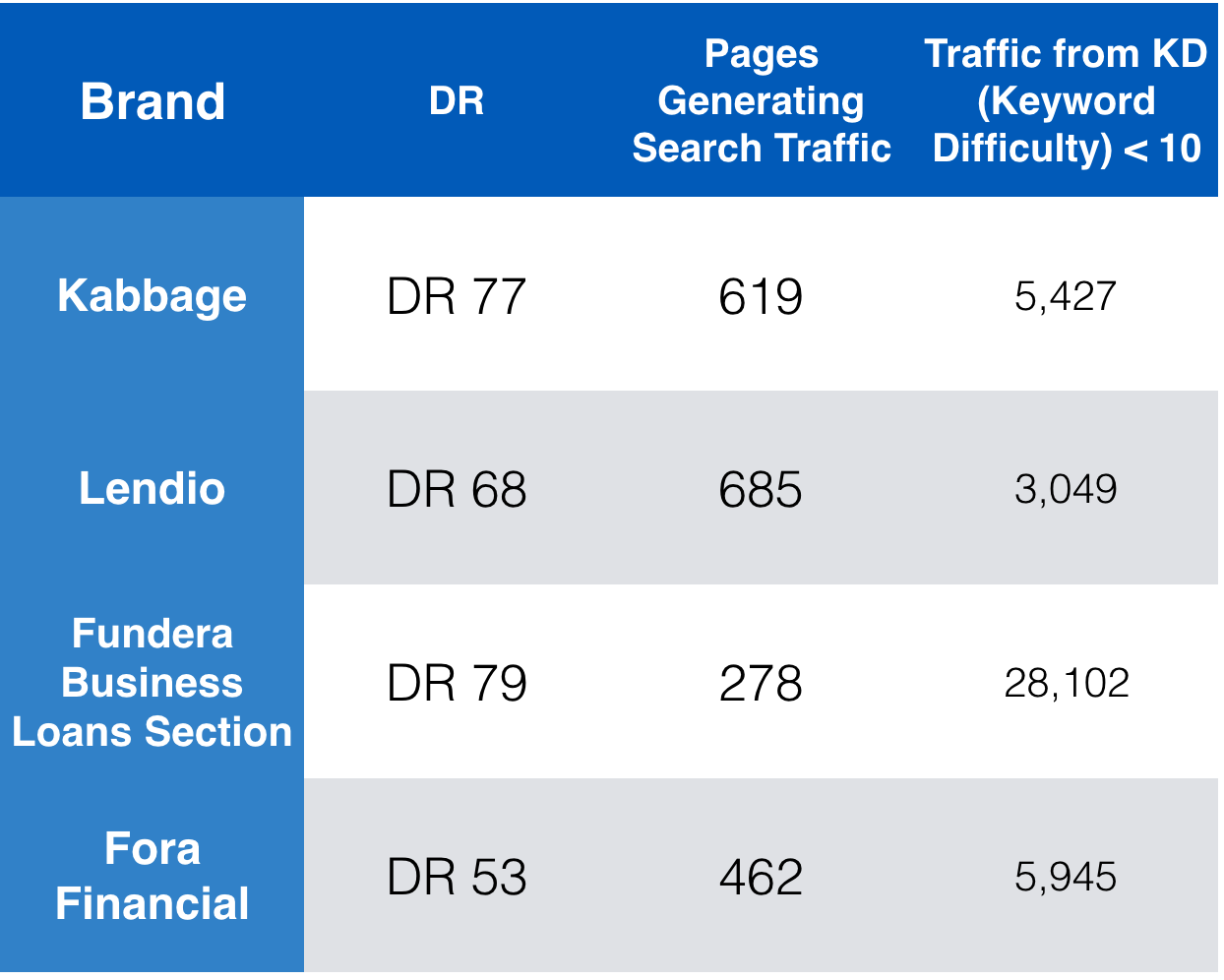
A couple metrics stand out already:

Fundera’s business loan section generates 5x as much traffic from easy keywords as Kabbage and Lendio, despite having fewer than half of the pages (and having a comparable amount of domain strength to Kabbage).

This implies Fundera’s content strategy has efficiencies compared to Kabbage and Lendio.

Further, with a significantly weaker domain, Fora Financial is able to amass more easy traffic than both Kabbage and Lendio, with 25%-30% fewer pages.

How to integrate Keyword Difficulty into a content strategy

1. How to integrate the easiest of keywords

Even though we can see that Fundera and Fora Financial have preferential content strategies, it’s not the best idea to blindly follow their paths.

When we perform content research, we prefer to look across the entire industry.

Pretty much every company does at least a few things effectively and have found some soft spots. By analyzing at an industry level, we can gain a better understanding of which topics are soft spots, and create a master list of those quick wins topics to target:
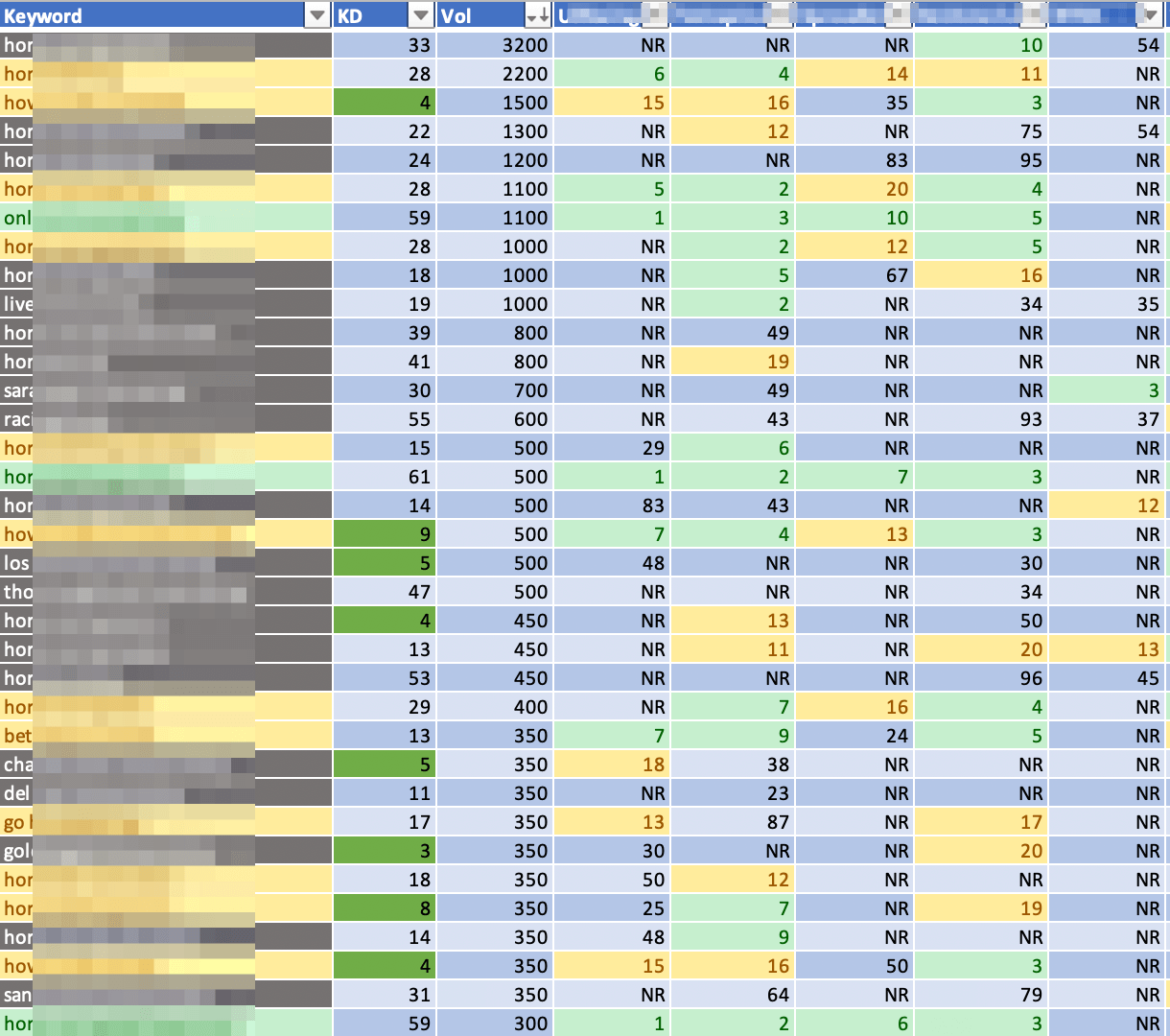
Keywords under the KD column are highlighted if they are less than 10. Just by glancing through this cut off list, you can see there are opportunities that none of these list companies are generating traffic from.

(Keep in mind that a single page typically ranks for many keywords within a given topic, so each keyword on this list doesn’t represent a piece of content)

2. How to integrate the most difficult keywords

On the opposite end of the spectrum, we have the most difficult keywords. If you look on the list above, there are a couple green background blurred keywords. These are the most important keywords in this small sampling. Not coincidentally, they are the highest keyword difficulty, and many of these competitors are already ranking well. These are the “business loans” and “small business loans.”

In this instance, there is no decision to be made. Content needs to be created for the purpose of ranking these types of keywords, and as many links as necessary must be built.

3. What to do with the “in between” keywords

In the third category, there are keywords that require a varying level of links. Unless your domain is super strong, you won’t outrank your competitors simply by throwing up a piece of content and walking away.

At the same time, there isn’t a herculean level of effort needed either.

For these sorts of keywords, there are a few factors to consider:

  1. What is the ranking and the domain rating of the given competitor?
  2. How many links of a given quality have been built to that page?
  3. How dedicated is the page to that given term?

Let’s run through an example:

Let’s take the term “secured line of credit”. It’s a keyword difficulty of 20 — not the easiest, and not crazy difficult either.

If we throw that search term into Google, we get the following result:
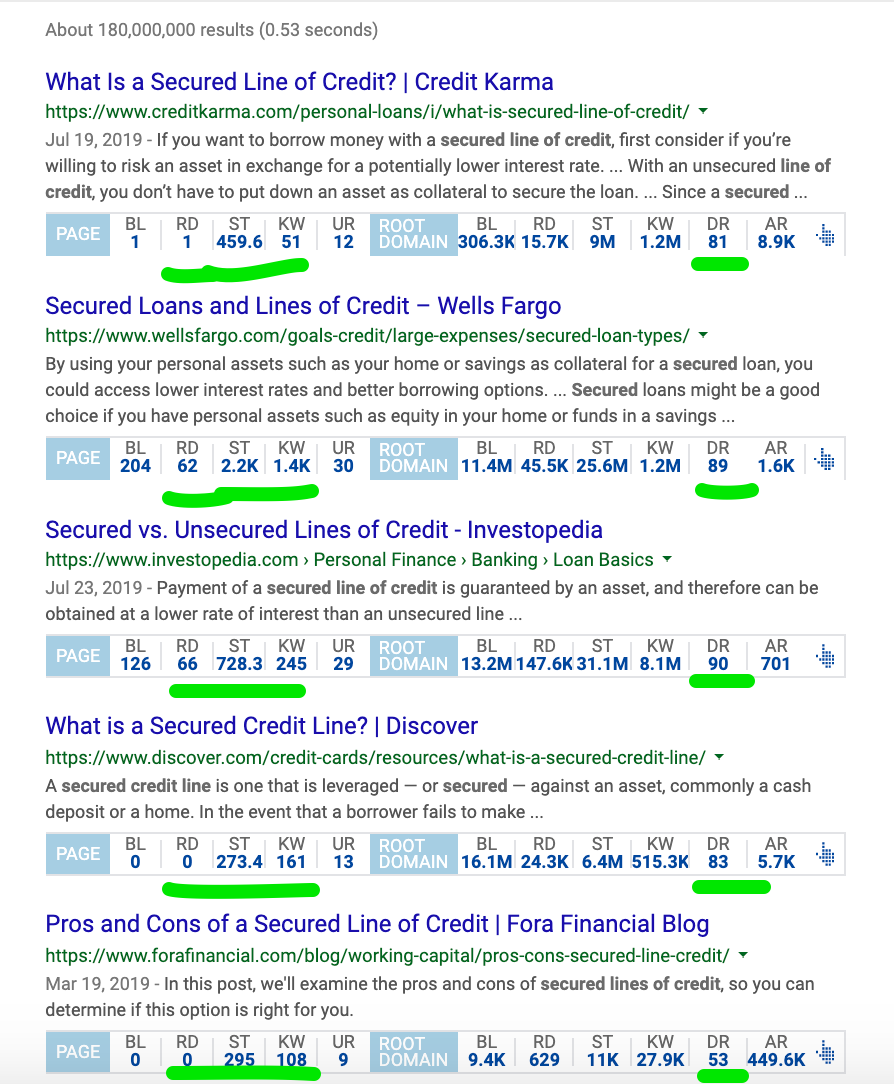
Let’s take a quick look at the top 5:
CreditKarma – A page dedicated to secured line of credit
Wells Fargo – A page discussing secured loan types
Investopedia – A page discussing the differences between secured and unsecured lines of credit
Discover – A page dedicated to “secured credit lines”
Fora Financial – A page dedicated to the pros and cons of secured line of credit

Now let’s zoom in on some metrics:
Page RD: The number of domains linking to the page
Page ST: The estimated search traffic that page receives
Page KW: The number of keywords that page appears in the Top 100 for
Root Domain DR: The domain rating of the website

CreditKarma, with a weaker domain than the rest of the top 4, as well as just one backlink (compared to 62 and 66 RD of spots 2 and 3 respectively), is able to take the number one spot. Discover comes in at number 4, with 0 backlinks, and Fora Financial, which has the second most precise topic, comes in at number 5 with a significantly weaker domain than the rest of the page one search results.

What can we take away from the search results page here?

Google is heavily favoring precision — the sites that have dedicated pages to the specific topic of “secured line of credit” are getting a massive boost in the search results page.

Just how specific is Google being here? Notice that Discover has a page titled “How does a secured credit line work?”

Let’s Google “Secured credit line”:

The Discover page now has both the #1 ranking as well as the rich snippet, and the CreditKarma post has fallen to #4.

Since both companies invested resources to create a page, who made the better decision?

CreditKarma did.

While both keywords appear to have a similar level of difficulty, the search traffic for “secured line of credit” is about 700 searches per month, while “secured credit line” is only 140.

Given this information, you’d feel comfortable placing the secured line of credit topic as it’s own page, and plan on building a few links to that page, in order to be competitive with the top half of first page of the search results.

If we replicate this strategy across each keyword topic, we’ll wind up with a list of easy, medium, and difficult keywords that we can use to create pieces of content.

3) Are your pages structured properly?

Years ago (and to most people still today), “on site optimization” meant having a relevant URL, and placing your main keyword somewhere in your page title, meta description, and at various points in your content.

As you may imagine, there are better ways to do things.

There are two core concepts that function as the backbone of really high quality on site optimization:

1) Top results show what is possible, not what is right

All things being equal, Google shows us which results it likes best for a given search term by listing them as the top rankings.

While a beginner strategy might be to include your main keyword in the URL, page title, meta description, an intermediate strategy might replicate what top pages in Google are doing. There are two mistakes with this approach:

  1. The algorithm Google uses to rank websites for a given search term is different for every search query (there is no “one size fits all” key)
  2. The top pages might have poor on site SEO!

While it is intuitive that Google doesn’t use the exact same algorithm across every single keyword in the universe, the second point might appear strange.

Why would a page be ranking high if it has poor SEO? The answer could be one of many reasons…

The website could be significantly more powerful than the competition, or of a different format (e.g. a .gov website). There is also evidence that there is a sort of Grandfathering system that exists (independent of a page’s on site, if pages have existed at #1 for a while, and generated a good CTR, and users aren’t returning to Google… they are probably answering the search query)

For these reasons, analyzing the top search results is helpful, but primarily so via correlations (what themes do the top results have in common?). In a minute, we’ll walk through one type of correlation analysis we’d perform on a page dedicated to they keyword  topic “small business loans”.

Before we do, there’s one other key consideration we should mention:

2) Optimization does not occur at a page level, it occurs at a Zone level

Content Zones are an invented term we’ve started using internally to provide guidance about where to optimize.

There is no such thing as optimizing at a page level. In reality, there only exist a group of optimized portions of a page. 

Google can tell the difference between:

  • Navigation
  • Footer
  • Sidebars
  • Headers
  • Paragraphs
  • Images

The single biggest mistake that people make when optimizing pages is to optimize the page “overall”.

This error results in portions of the page being over-optimized while others are under-optimized.

Small business loans on site example

Let’s actually look through the search results for “small business loans” and see what the top results are doing compared to a sample client page. We’ll pretend that Fora Financial’s page is the client page, and we’ll compare it to the top results.

Here is a screenshot from one of our proprietary on-site SEO tools. We look at over 500 on site metrics and determine correlations for a specific search query. In the screenshot below, anything with lower than a -.70 rating in the “Best of Both By Page” column means there is a >95% statistical significance in a positive ranking correlation:

While this is the level of detail that it takes to win at the on page level, and is necessary for our most important keywords, for this example, we’ll only be looking at keyword density.

Keyword density is simply the percentage of time that a certain keyword appears on a given page. By examining density, we automatically factor in the length of content on the page.

Keyword Density At a Page Level

You can see that we are comparing Fora Financial’s page to the top 6 of the search results:

We’ve highlighted a few boxes here.

Clean Word Count refers to the amount of words on the page that are visible to the human eye (it also counts things like menu items, or text when you hover a link). Inside of these clean words, we can see that the preselected group of keywords appears 8.3% of the time, and the other results typically appear 6.9%-10.8%. As a note, sba.gov can be ignored in this instance since it is a .gov website which skews any of its SEO requirements.

Our main takeaway from the Clean Density would be that we are in a healthy middle position. If we wound up increasing our density a little higher, that would be fine, so we can proceed without too much discretion here.

The following columns have been truncated to look solely at the Clean Keyword % of certain words, listed above the boxes.

For “business” we are towards the top of the range and are okay there. For “business loan”, we are a little too high and we’d probably want to decrease our density down to 1.1% or so.

For “loan”, we have a little more room to run but are pretty fine. We can definitely increase the density of “loans” to at least 2.25% or so, and we are fairly behind on “small” — we’d want to increase that to at least 2%.

As you can see, we use the other results to determine reasonable maximums, and then begin to optimize from there.

Keyword Density Related to Content Zones

From reviewing the keyword density overall, we can see that there is some work to be done on density for our various keywords, however, things seem to be in an okay place. Once we start to look at Content Zones though, everything changes:

Immediately, we can see problems:

  • Way too many instances of keywords in H1, H2, H3 compared to page 1 avg
  • Okay amount of H4, H5, H6
  • Way too many instances of H3 keywords
  • Need amount 3x as many keywords in paragraphs
  • Could increase H1 and H2 a bit too

When we looked at keyword density, everything was mostly within the range of the other top results, if a little lower. However, here we see the classic error: lack of balance within each Content Zone, making this page simultaneously over-optimized and under-optimized.

The proper way to proceed is to make the necessary changes, and then see where we fall on the rankings. We can continue to make tweaks and tunes — the most important pages will likely take three or four iterations to really nail.

The Trifecta of SEO

Fundamentally, there are only three critical elements to SEO:

  1. Do you have the right amount of links?
  2. Do you have the right amount of content?
  3. Is that content structured in an optimal way?

The challenging (and fun!) part of SEO is taking those three simple ideas, and breaking them down scientifically into actionable steps, monitoring data, and then testing, testing, and testing until you find the winning combination.

Lendio and Kabbage are able to make millions each month organically because they have their SEO down to a science. This is the same formula and strategy that can be applied across any industry.

There are leaders waiting to vacate their thrones 🙂

If you are interested in mapping out an SEO strategy for your company, you can fill out this form and start a conversation.


The post How to Turn Organic Search into your Most Powerful Marketing Channel appeared first on SearchTides.


from SearchTides https://searchtides.com/how-to-turn-organic-search-into-your-most-powerful-marketing-channel/

View: Generating Millions of Organic Visitors is Straightforward (Just Follow These Steps)

https://i.pinimg.com/originals/e2/8d/ff/e28dffa3c5396b5064779e3f589cf255.png

Note: This article is the first in a series of topics written with the goal of breaking down exactly how to turn Search/Organic Search into one of the most profitable marketing channels of a given company. This first article provides background information into how Google works and thinks from a company perspective, which trickles into every facet of their search engine algorithm.


Generating millions of organic visitors, seemingly on autopilot, is a dream scenario for most businesses.

Due to its high level of desirability, we tend to assume a plan to do this needs to be complex.

As with most assumptions, they make an ass out of you and me

Deconstructing Google’s desires at a high level is not particularly difficult:

What Google Wants

  • Google (Alphabet) wants people to use its search engine (since 90% of its revenue comes from advertising, with the majority of that money coming from Google Ads fka Google Adwords)

Shocking 😉

Of course, in order for people to actually use Google’s search engine, they need to feel like the top search results are answering their questions

(In fact, if you look at any modifications that Google has made to the search results page over the past couple of years, they have pretty much been with the purpose of getting the user those results FASTER and more PRECISELY)

From a business perspective, it is a risk for Google to let any old website show up at the top of the search results page.

Because if they have some poor sites on there, users could theoretically move off of Google and to something like Bing or DuckDuckGo (we can laugh, but Bing has actually increased its marketshare by 30% in the last year)

At the very top of the search results, where there are lots of clicks (“votes”) user experience is used as a ranking factor. If people continually return to Google ten seconds after landing on your website, click on another result, and then never return to Google, it is reasonable to conclude that your page did not provide the answer to the search query.

If you start to look from this angle, now all of the sudden “making quality content”, “loading your page quickly”, and “creating a quality user experience” start to make a little bit more sense.

Even though it’s flashy to speak about user experience, that’s still not what will generate millions of organic visitors each month.

Website Trust and Third Party Endorsements Lead to Rises in the Search Results

At the most basic level, Google TRUSTS the top search results.

The more often Google puts a website at the top of the search results, the greater the level of trust from Google.

Of course, a website appearing at the top of Google has already earned that trust.

How did they do that?

Through links from other websites.

When the internet first started and Google’s founders issued their Stanford Thesis, the web relied on links as endorsement signals.

the web also relied on Geocities traffic counters

But mostly links. Links were pretty much the only way that a website could tell a visitor that it thought a second website was valuable enough to send the user to.

An endorsement from the early stages of the internet.

Google’s search engine still operates as a link-based search engine.

The simple reason is that links work best to analyze the interactions between trillions of web pages.

Now, that doesn’t mean that Google doesn’t take other factors into consideration (we’ll talk about that later).

And it doesn’t mean that EVERY search engine is a link-based search engine.

For example, you can build links indefinitely to an Amazon product page, and it will never “rise” in Amazon’s search results because their algorithm is all intent-based (Amazon only cares about how much revenue is generated per view of a given page)

But, Google’s search engine is based off of links, aka, endorsements.

So in the early stages of Google, more links = more endorsements.

The modern Google search algorithm

As you can imagine, this straightforward formula brought in a ton of spam, mass link building, and other nefarious methods of gaming the Google search engines.

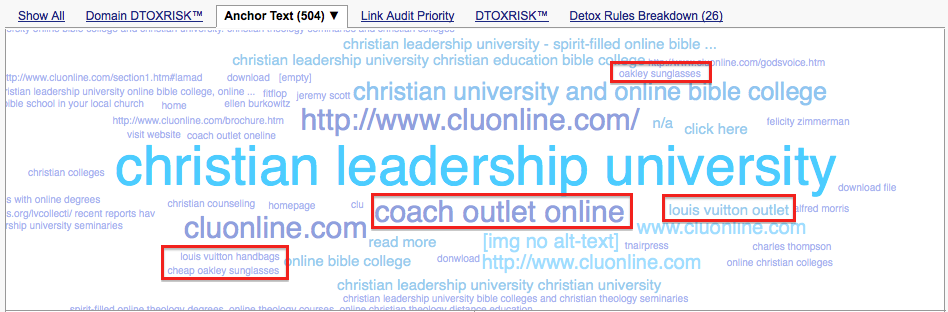
Does anyone actually know why all the anchor text spam had to do with knockoff purses?

Anyway, this war of exploitation led Google to move through various iterations, until we [conveniently] landed at where we are today.

The Big Questions Google Wants to Know About Your Link

A link is not a link. Links are various types of fruit, and not every link can be Passion Fruit, which everyone knows is the best fruit.

Some of them are Dorians. Yuck.

Buzzwords are thrown around frequently in SEO. As we all know deep down inside, buzzwords are a great way to pretend to understand a topic 🙂

So let’s break things down without them.

Keep your eyes peeled though, because you’ll see the origin where many of these marketing buzzwords come from.

And you’ll definitely be able to brag about this at the next party you attend

If you get this reference, please message me, we need to be friends

Here are some questions Google asks about a given link pointing to your website:

Does it MAKE SENSE that this page from Website A is linking to your site? 

If I am a website that spreads the love of Passion Fruit to the world, what types of websites might it make sense naturally to also want to spread the Passion Fruit word with me?

  • Websites devoted to fruits
  • Grocery stores
  • Recipes
  • Cooking shows
  • Travel websites
  • Etc

What intuitively “makes sense” is called relevancy. The more relevant the content of either a website or a webpage that is linking to my site, the more powerful the link is.

Ideally, the entire linking website is relevant to my site. However, if that’s not the case, we can typically make the page relevant (creating a page title, article name, URL, and content relevant to Passion Fruit).

How TRUSTWORTHY is Website A?

Not all sites can be relevant because not all sites discuss all topics. However, a site can be trustworthy independent of its topic.

Trust is a little more complex to rate/rank than relevance, but here are a few ways that Google attempts to answer this question:

  • How trustworthy are its own links?
  • Does this website appear to be a real business?
  • How much organic traffic does this website receive?
  • Is this website getting traffic from multiple sources?
  • How freely is this website giving out links?

Then you get bonus points for inherently trusted sites, such as domains that an average person cannot create (edu/gov)

Let’s break down some of these questions though:

“How trustworthy are its own links?”

This question seems to be a bit fractal, because it appears that you can just keep asking it indefinitely.

In reality, there is a concept called “seed sites”, which we won’t get into details during this article. The short version is, for a given industry (law, information, media, finance), there are a handful of sites that are considered the “core trusted sources” (lawyers.com, Wikipedia, USAToday, Forbes). The closer a link is from one of these sites, the more TRUSTWORTHY that link.

“Does this website appear to be a real business?”

As a core countermeasure to the legion of faceless websites that were built to game the Google Search Engine, Google wants to highlight websites that appear to be real businesses. (Remember, this is a de-risking strategy)

Real businesses have author profiles, they have employees on LinkedIn, they have active Facebook pages, they have easy ways of contacting the business, its address and phone number are readily available online.

“How much organic traffic does this website receive?”

This question is one of the secret ways that SearchTides determines trust. Remember, Google puts all its efforts into determining which websites deserve to appear at the top of the search results, where they will receive traffic.

Therefore, a website that generates lots of organic traffic (especially for search terms that don’t include your brand name) has been given that checkmark with Google.

“Is this website getting traffic from multiple sources?”

Hey, maybe we shouldn’t all have given one company access to most of the internet’s traffic data by installing Google Analytics across all our sites, but here we are!

Real businesses, aka websites built not for the sole purpose of appearing high in the Google search results, should generate traffic from a variety of traffic sources.

“How freely is this website giving out links?”

And lastly from the list, one metric that is genuinely one of the secret metrics that we track. I’ve decided to be bold and mention it in this article because it’s also a bit of a prediction.

If a website has a total of 10 outbound links (links to other websites), each of those outbound links is considered “rare” (implying a greater level of trust from the linking website).

If a website has 1,000,000 links across 1,000 webpages, and is linking to a wide variety of topics, that is considered the opposite.

One of our bold predictions for 2020 is that Google will start to devalue websites that link out liberally and to a wide range of sources.

How IMPORTANT is this page on Website A?

This question is a little more straightforward:

  • How frequently do visitors see this page (homepage vs. deep inner page)
  • How frequently is the content on this page updated? (proxy for internal attention/value)
  • How many links are pointed to this page (both internal and external links)

And then finally, a derivative of the above, how important is the link placement on the page?

Google understands the difference between navigation links, footer links, author bio links, sidebar links, and contextual links (link placed in the meat of the content itself).

Contextual links carry the highest value, since they are theoretically related to the core topic of that page itself (theoretically carrying the highest level of relevance).

How Can We Use This Information?

Google wants to make money. To do so, Google needs users to use its search engine.

Which means the top results need to answer the user’s queries, otherwise, they will use other search engines.

Which means Google is TRUSTING the top search results.

Google uses the measurement of LINKS to allow webpages to rank at the top for a given search query

It used to use the raw number of links, but that measurement system got wildly exploited.

Currently, Google uses a wide variety of factors to assign a value of a given link. These include:

  • The relevance of the website linking to the target website
  • The trustworthiness of the linking website
  • The importance/rarity of the link itself

Could SEO really be as straightforward as “properly build as many of these quality links as is necessary to have a competitive advantage”?

If you sprinkle in the right content and top it off with the right technical pieces, the answer is yes*

*Yes, the answer is yes. Of course, doing that successfully is a tough, tough endeavor, but deploying such a strategy is exactly what we’re going to explore in the rest of this series.


PS, if you’re looking for a more advanced breakthrough of actual strategy, you can check out our detailed analysis of the business lending space.

The post View: Generating Millions of Organic Visitors is Straightforward (Just Follow These Steps) appeared first on SearchTides.


from SearchTides https://searchtides.com/view-generating-millions-of-organic-visitors-is-straightforward-just-follow-these-steps/

Sunday, August 25, 2019

How Lendio and Kabbage Make Millions Each Month With Organic Traffic

https://searchtides.com/wp-content/uploads/2019/07/Screenshot-2019-07-08-22.15.09.png

Want to see exactly how the winners in the business loans space use organic traffic to make millions of dollars every single month?

TL;DR

  • They increase their website power at a specific rate with link building
  • They rank for over 125,000 keywords through a precise content strategy
  • Their pages are meticulously structured to maximize traffic from Google

What’s the value of Lendio and Kabbage’s traffic?

Using various research tools, we can provide an estimate of the amount of organic traffic a page or website receives each month. Additionally, we can determine how much money that organic traffic would cost each month to acquire via Google Ads (i.e. the cost if you were using PPC to acquire that traffic).

Comparing some of the companies who are at the top of the search results for business loans related terms, you can see that even a very small amount of traffic is worth a tremendous amount of money.

Lendio and Kabbage each generate over $6mm a year in traffic value.

For NerdWallet, a single page, their small business loans page, generates ~$250k/mo in organic traffic.

Fundera’s business loans section tops everyone at a whopping $2.4mm per month in organic traffic value:


How can these sites generate seemingly unlimited free traffic?

Even though the strategies and execution of  a successful campaign are complex, the “what” of organic traffic is fairly straightforward:

  1. Do you have a stronger, more ‘powerful’ website than your competition?
  2. Do you have all the necessary pages on your site to catch the most search traffic?
  3. Are those pages structured properly?

That’s the formula — answer those questions yes and you’ve unlocked a mountain of repeat visitors who inherently trust your site because they found it themselves.

1) Do the winners have stronger websites than the losers?

Using Domain Rating (DR), a 1-100 logarithmic rating, we can measure the strength of a given website, comparing the winners to losers in the industry:

Undeniably, the more powerful the website (the higher the “DR”), the more traffic generated. (Remember, NerdWallet’s entry is a single page on their website).

How to get a more powerful website?

There’s only one way to get a more powerful website: Build links

Build links increases the amount of referring domains (the amount of websites) that point to your own website.

By building quality links, you will increase the amount of powerful domains that point to your site. This will increase your authority, or DR (Domain Rating). With a high enough DR, you will appear higher in the search results by default and generate more organic traffic.

Link Building Leads to a More Powerful Website and More Organic Traffic

Here are some great examples. Nerdwallet has been steadily building links since January 2014, and their traffic has been increasing the entire time (it’s up to 12.3mm monthly visitors).

Lendio really started to ramp up their link building in July of 2016, with the number of referring domains peaking in March of 2018.

But then, they stopped, and their referring domains started to decrease. So did their organic traffic.

Only in the last month or two have they picked their referring domains back up, and, unsurprisingly, their organic traffic increased as well.

How actively are the winners building links?

The question isn’t if the winners are building link, but rather: how much effort is being put into this process right now?

For example, Lendio paused their link building in March of 2018. Have they fully restarted? Here’s where the winners stand currently:

(Numbers are referring domains)

It looks like Lendio is building about 167 new referring domains per month, and Kabbage is around 300 per month. However, since their prior link building efforts may not have been the highest quality, they are losing significant amount of domains each month.

How to outperform the winners from a link building perspective

There are two different opportunities to catch up to the industry leaders, but they both come from the same principle:

Higher quality backlinks will remain live more frequently (you won’t ‘lose’ them), and higher quality backlinks are worth more (not all links are created equal)

Higher quality backlinks stay live more frequently:

Here’s a few examples of the ratios on gained/lost links that SearchTides has for our clients:

Controlling link relationships is a competitive advantage that leads to fewer links lost, which allows winners to be caught up to.

Higher quality link building means each link is worth more:

Although it sounds intuitive, there’s value in explicitly saying: not all links are created equal. There are a variety of filters that can be used to judge the quality of a link; for this conversation, it’s easier to use raw power (domain rating).

The stronger the domain linking to your site, the stronger the value of that link is.

As an example, here is the breakdown of the strength of the domains pointing to the Kabbage and Lendio websites, compared to what is typical of a SearchTides link building campaign:

If you build higher quality backlinks than the current winners, and you have a competitive advantage.

2) What’s the optimal content creation strategy to use?

How can you tell if a company has a successful content creation strategy?

You look at the number of page one rankings over time.

The most profitable terms in a space:

  • Small business loans
  • Business Loans
  • Etc

Are all well known and are a defined number of keywords.

If your website is ONLY talking about business loans or small business loans, even if you are moving from the #10 to #1 spot for those keywords, you aren’t increasing the number of keywords you rank for.

That’s what good content does.

New articles allow you to target additional keywords.

Which then work their way onto page one, and you generate search traffic as a result.

Let’s look at Kabbage and Lendio:

Although both sites had significant rises in page one rankings initially, they have both experienced a decrease in page one rankings since.

This drop is not due to the major keywords, such as “small business loans”, since Kabbage/Lendio remain on the first page, but rather, this decrease stems from the additional keywords targeted with content.

Because the number of page one rankings are decreasing, it is reasonable to conclude that other sites have better content strategies than these two.

What are good content strategy rules of thumb?

Typically, there are three categories of keywords:

  • Keywords you can rank for without any help (e.g. by posting a new page)
  • Keywords that require a bit of link building
  • Keywords that need require a metric ton of link building

A good content strategy develops content for all three categories, supported by the relevant amount of link building to appear high in the search results.

Which keywords fit into what category depends on the overall strength of your website.

A DR90’s “easy” keywords could be nearly impossible for a DR10.

Luckily, keywords can be rated based off difficulty, which means that the safest of all content strategies heavily relies on generating lots of traffic from low Keyword Difficulty (KD) queries.

Here’s the breakdown of traffic coming from Keyword Difficulty scores of less than 10:

A couple metrics stand out already:

Fundera’s business loan section generates 5x as much traffic from easy keywords as Kabbage and Lendio, despite having fewer than half of the pages (and having a comparable amount of domain strength to Kabbage).

This implies Fundera’s content strategy has efficiencies compared to Kabbage and Lendio.

Further, with a significantly weaker domain, Fora Financial is able to amass more easy traffic than both Kabbage and Lendio, with 25%-30% fewer pages.

How to integrate Keyword Difficulty into a content strategy

1. How to integrate the easiest of keywords

Even though we can see that Fundera and Fora Financial have preferential content strategies, it’s not the best idea to blindly follow their paths.

When we perform content research, we prefer to look across the entire industry.

Pretty much every company does at least a few things effectively and have found some soft spots. By analyzing at an industry level, we can gain a better understanding of which topics are soft spots, and create a master list of those quick wins topics to target:

Keywords under the KD column are highlighted if they are less than 10. Just by glancing through this cut off list, you can see there are opportunities that none of these list companies are generating traffic from.

(Keep in mind that a single page typically ranks for many keywords within a given topic, so each keyword on this list doesn’t represent a piece of content)

2. How to integrate the most difficult keywords

On the opposite end of the spectrum, we have the most difficult keywords. If you look on the list above, there are a couple green background blurred keywords. These are the most important keywords in this small sampling. Not coincidentally, they are the highest keyword difficulty, and many of these competitors are already ranking well. These are the “business loans” and “small business loans.”

In this instance, there is no decision to be made. Content needs to be created for the purpose of ranking these types of keywords, and as many links as necessary must be built.

3. What to do with the “in between” keywords

In the third category, there are keywords that require a varying level of links. Unless your domain is super strong, you won’t outrank your competitors simply by throwing up a piece of content and walking away.

At the same time, there isn’t a herculean level of effort needed either.

For these sorts of keywords, there are a few factors to consider:

  1. What is the ranking and the domain rating of the given competitor?
  2. How many links of a given quality have been built to that page?
  3. How dedicated is the page to that given term?

Let’s run through an example:

Let’s take the term “secured line of credit”. It’s a keyword difficulty of 20 — not the easiest, and not crazy difficult either.

If we throw that search term into Google, we get the following result:

Let’s take a quick look at the top 5:
CreditKarma – A page dedicated to secured line of credit
Wells Fargo – A page discussing secured loan types
Investopedia – A page discussing the differences between secured and unsecured lines of credit
Discover – A page dedicated to “secured credit lines”
Fora Financial – A page dedicated to the pros and cons of secured line of credit

Now let’s zoom in on some metrics:
Page RD: The number of domains linking to the page
Page ST: The estimated search traffic that page receives
Page KW: The number of keywords that page appears in the Top 100 for
Root Domain DR: The domain rating of the website

CreditKarma, with a weaker domain than the rest of the top 4, as well as just one backlink (compared to 62 and 66 RD of spots 2 and 3 respectively), is able to take the number one spot. Discover comes in at number 4, with 0 backlinks, and Fora Financial, which has the second most precise topic, comes in at number 5 with a significantly weaker domain than the rest of the page one search results.

What can we take away from the search results page here?

Google is heavily favoring precision — the sites that have dedicated pages to the specific topic of “secured line of credit” are getting a massive boost in the search results page.

Just how specific is Google being here? Notice that Discover has a page titled “How does a secured credit line work?”

Let’s Google “Secured credit line”:

The Discover page now has both the #1 ranking as well as the rich snippet, and the CreditKarma post has fallen to #4.

Since both companies invested resources to create a page, who made the better decision?

CreditKarma did.

While both keywords appear to have a similar level of difficulty, the search traffic for “secured line of credit” is about 700 searches per month, while “secured credit line” is only 140.

Given this information, you’d feel comfortable placing the secured line of credit topic as it’s own page, and plan on building a few links to that page, in order to be competitive with the top half of first page of the search results.

If we replicate this strategy across each keyword topic, we’ll wind up with a list of easy, medium, and difficult keywords that we can use to create pieces of content.

3) Are your pages structured properly?

Years ago (and to most people still today), “on site optimization” meant having a relevant URL, and placing your main keyword somewhere in your page title, meta description, and at various points in your content.

As you may imagine, there are better ways to do things.

There are two core concepts that function as the backbone of really high quality on site optimization:

1) Top results show what is possible, not what is right

All things being equal, Google shows us which results it likes best for a given search term by listing them as the top rankings.

While a beginner strategy might be to include your main keyword in the URL, page title, meta description, an intermediate strategy might replicate what top pages in Google are doing. There are two mistakes with this approach:

  1. The algorithm Google uses to rank websites for a given search term is different for every search query (there is no “one size fits all” key)
  2. The top pages might have poor on site SEO!

While it is intuitive that Google doesn’t use the exact same algorithm across every single keyword in the universe, the second point might appear strange.

Why would a page be ranking high if it has poor SEO? The answer could be one of many reasons…

The website could be significantly more powerful than the competition, or of a different format (e.g. a .gov website). There is also evidence that there is a sort of Grandfathering system that exists (independent of a page’s on site, if pages have existed at #1 for a while, and generated a good CTR, and users aren’t returning to Google… they are probably answering the search query)

For these reasons, analyzing the top search results is helpful, but primarily so via correlations (what themes do the top results have in common?). In a minute, we’ll walk through one type of correlation analysis we’d perform on a page dedicated to they keyword  topic “small business loans”.

Before we do, there’s one other key consideration we should mention:

2) Optimization does not occur at a page level, it occurs at a Zone level

Content Zones are an invented term we’ve started using internally to provide guidance about where to optimize.

There is no such thing as optimizing at a page level. In reality, there only exist a group of optimized portions of a page. 

Google can tell the difference between:

  • Navigation
  • Footer
  • Sidebars
  • Headers
  • Paragraphs
  • Images

The single biggest mistake that people make when optimizing pages is to optimize the page “overall”.

This error results in portions of the page being over-optimized while others are under-optimized.

Small business loans on site example

Let’s actually look through the search results for “small business loans” and see what the top results are doing compared to a sample client page. We’ll pretend that Fora Financial’s page is the client page, and we’ll compare it to the top results.

Here is a screenshot from one of our proprietary on-site SEO tools. We look at over 500 on site metrics and determine correlations for a specific search query. In the screenshot below, anything with lower than a -.70 rating in the “Best of Both By Page” column means there is a >95% statistical significance in a positive ranking correlation:

While this is the level of detail that it takes to win at the on page level, and is necessary for our most important keywords, for this example, we’ll only be looking at keyword density.

Keyword density is simply the percentage of time that a certain keyword appears on a given page. By examining density, we automatically factor in the length of content on the page.

Keyword Density At a Page Level

You can see that we are comparing Fora Financial’s page to the top 6 of the search results:

We’ve highlighted a few boxes here.

Clean Word Count refers to the amount of words on the page that are visible to the human eye (it also counts things like menu items, or text when you hover a link). Inside of these clean words, we can see that the preselected group of keywords appears 8.3% of the time, and the other results typically appear 6.9%-10.8%. As a note, sba.gov can be ignored in this instance since it is a .gov website which skews any of its SEO requirements.

Our main takeaway from the Clean Density would be that we are in a healthy middle position. If we wound up increasing our density a little higher, that would be fine, so we can proceed without too much discretion here.

The following columns have been truncated to look solely at the Clean Keyword % of certain words, listed above the boxes.

For “business” we are towards the top of the range and are okay there. For “business loan”, we are a little too high and we’d probably want to decrease our density down to 1.1% or so.

For “loan”, we have a little more room to run but are pretty fine. We can definitely increase the density of “loans” to at least 2.25% or so, and we are fairly behind on “small” — we’d want to increase that to at least 2%.

As you can see, we use the other results to determine reasonable maximums, and then begin to optimize from there.

Keyword Density Related to Content Zones

From reviewing the keyword density overall, we can see that there is some work to be done on density for our various keywords, however, things seem to be in an okay place. Once we start to look at Content Zones though, everything changes:

Immediately, we can see problems:

  • Way too many instances of keywords in H1, H2, H3 compared to page 1 avg
  • Okay amount of H4, H5, H6
  • Way too many instances of H3 keywords
  • Need amount 3x as many keywords in paragraphs
  • Could increase H1 and H2 a bit too

When we looked at keyword density, everything was mostly within the range of the other top results, if a little lower. However, here we see the classic error: lack of balance within each Content Zone, making this page simultaneously over-optimized and under-optimized.

The proper way to proceed is to make the necessary changes, and then see where we fall on the rankings. We can continue to make tweaks and tunes — the most important pages will likely take three or four iterations to really nail.

The Trifecta of SEO

Fundamentally, there are only three critical elements to SEO:

  1. Do you have the right amount of links?
  2. Do you have the right amount of content?
  3. Is that content structured in an optimal way?

The challenging (and fun!) part of SEO is taking those three simple ideas, and breaking them down scientifically into actionable steps, monitoring data, and then testing, testing, and testing until you find the winning combination.

Lendio and Kabbage are able to make millions each month organically because they have their SEO down to a science. For anyone in the space who is committed to taking a similar approach, their reward could too be a pot of that gold.

If you are interested in mapping out an SEO strategy for your company, you can fill out this form and start a conversation.


The post How Lendio and Kabbage Make Millions Each Month With Organic Traffic appeared first on SearchTides.


from SearchTides http://searchtides.com/how-lendio-and-kabbage-make-millions-each-month-with-organic-traffic/